

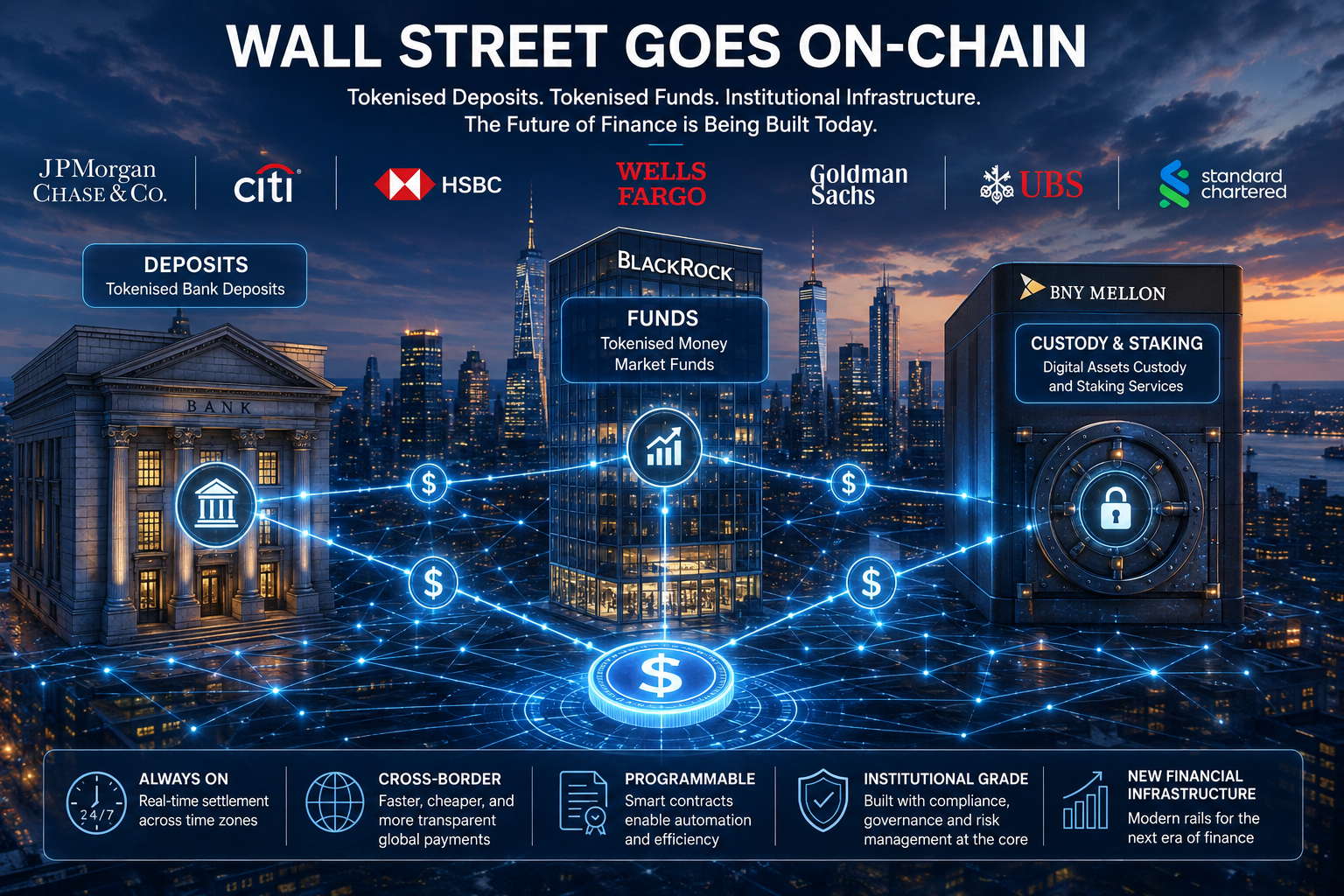
For years, discussions about blockchain in finance were largely centred on cryptocurrencies. Today, the conversation has changed.
Over the last 24 hours, three major announcements from some of the world’s largest financial institutions point to the same trend: traditional finance is moving beyond experimentation and beginning to rebuild core financial infrastructure using blockchain technology.
The announcements came from BNY Mellon, Wells Fargo and BlackRock. While each initiative addresses a different part of the financial system, together they tell a much bigger story.
1. BNY Mellon Expands into Crypto Staking
BNY Mellon, the world’s largest custodian bank, is continuing to deepen its digital asset business by moving into crypto staking services for institutional clients. This builds on the bank’s broader digital asset strategy, which already includes custody, tokenized deposits and blockchain-based recordkeeping.
Instead of simply safeguarding digital assets, custodians are beginning to help institutions generate yield while maintaining institutional-grade governance, reporting and risk management.
2. Wells Fargo Launches Tokenized Deposits
The bank plans to launch tokenized deposits for corporate clients this fall, starting with U.S. dollar and British pound deposits on its proprietary blockchain network. The deposits will support 24/7 payments, cross-border settlement and programmable transactions.
Unlike stablecoins, tokenized deposits remain bank liabilities and operate within the existing banking system. For corporate treasury teams, this could mean faster cross-border payments, continuous settlement outside traditional banking hours, reduced reconciliation delays, and automated payments through smart contracts
This places Wells Fargo alongside JPMorgan and Citi, which have already introduced similar tokenized deposit initiatives.
3. BlackRock Brings Tokenized Money Market Funds to Ethereum
BlackRock has launched a tokenized money market fund on Ethereum, extending its push into tokenized financial products.
The fund invests in familiar low-risk instruments such as cash, U.S. Treasury bills and repurchase agreements. What changes is not the underlying investment, but how ownership is represented. Instead of conventional fund records, investors hold blockchain-based tokens representing their ownership. The fund is also designed to qualify as an eligible reserve asset for regulated U.S. stablecoin issuers under the GENIUS Act.
| Institution | What they’re tokenizing | Purpose |
|---|---|---|
| BNY Mellon | Institutional staking services | Digital asset custody and yield generation |
| Wells Fargo | Bank deposits | Payments and settlement |
| BlackRock | Money market funds | Investment products and collateral |
Who Else Is Exploring Tokenisation?
The latest announcements from BNY Mellon, Wells Fargo and BlackRock are part of a much broader shift. Nearly every major global bank, asset manager and financial market infrastructure provider now has a tokenisation strategy, whether through live products, pilot programmes or industry consortia.
Global Banks
| Institution | Tokenisation Focus |
|---|---|
| JPMorgan Chase | Kinexys (formerly Onyx), tokenised deposits (JPM Coin), repo, collateral and cross-border settlement. |
| Wells Fargo | Tokenised deposits for corporate clients. |
| Citigroup (Citi) | Citi Token Services for tokenised deposits, payments and liquidity management. |
| HSBC | Tokenised deposits, digital bonds, tokenised gold and blockchain settlement infrastructure. |
| BNY Mellon | Digital custody, blockchain transfer agency, tokenised funds and staking services. |
| Goldman Sachs | GS DAP platform for digital bond issuance and tokenised capital markets. |
| UBS | Tokenised money market funds, digital bonds and institutional tokenisation initiatives. |
| Standard Chartered | Stablecoins, tokenised deposits and digital asset infrastructure. |
| Deutsche Bank | Asset tokenisation platforms and digital asset infrastructure. |
| Société Générale | Tokenised securities and regulated stablecoins through SG-FORGE. |
Asset Managers
- BlackRock — Tokenised money market funds (BUIDL), tokenised Treasury products and blockchain-based fund infrastructure.
- Franklin Templeton — One of the earliest managers to launch an on-chain money market fund.
- Fidelity Investments — Exploring tokenised investment products and digital asset infrastructure.
- Invesco — Participating in institutional tokenisation initiatives through DTCC and other market infrastructure programmes.
Market Infrastructure Providers
These organisations operate much of the world’s financial plumbing and are increasingly building tokenised infrastructure.
- DTCC — Developing tokenisation services for securities settlement with more than 50 financial institutions participating.
- Swift — Building a blockchain-based ledger connecting tokenised deposits across global banks for 24/7 cross-border payments.
- Visa — Developing tokenisation infrastructure that allows banks to issue and settle tokenised assets.
- Mastercard — Working with banks and market participants on tokenised payment infrastructure and settlement.
Rather than replacing the existing financial system, these institutions are rebuilding it with blockchain as the underlying infrastructure. The convergence of these efforts suggests that tokenisation is moving from isolated pilots to coordinated adoption across global capital markets.