
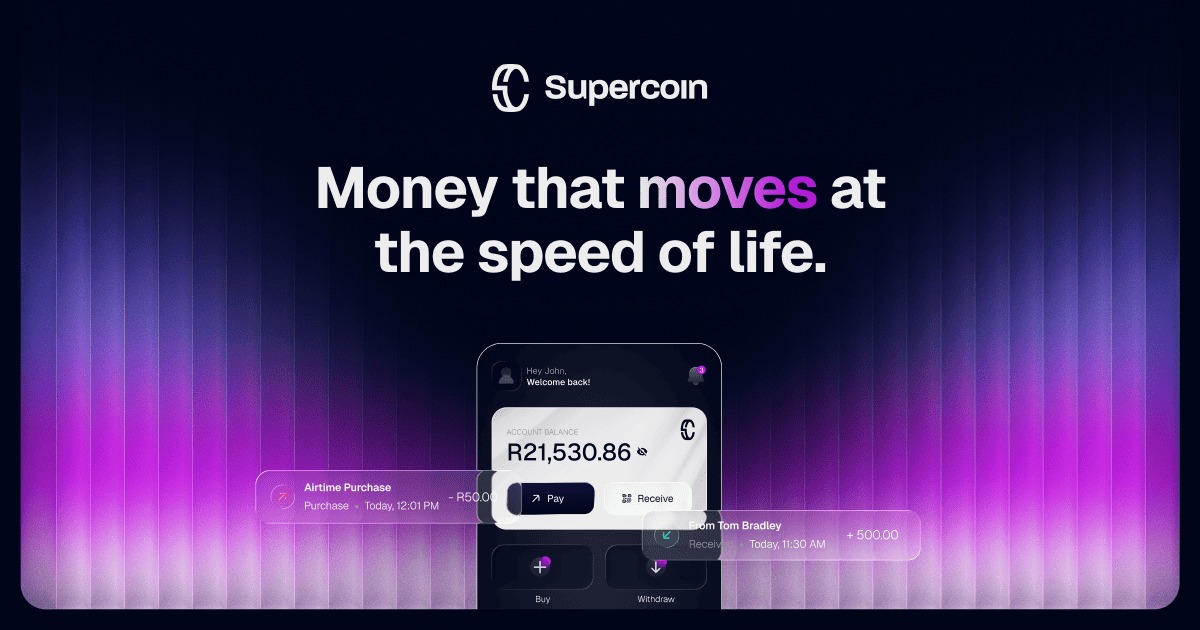
The global stablecoin market has evolved from a niche segment of the cryptocurrency industry into a critical component of digital payments infrastructure. While most of the market remains dominated by US dollar-linked tokens, a growing number of issuers are exploring local-currency stablecoins that can address domestic payment, settlement, and treasury needs. In South Africa, one of the latest entrants is ZARsc, a rand-backed stablecoin issued by Supercoin.
Built on the Solana blockchain, ZARsc is designed as a digital representation of the South African rand, with each token backed 1:1 by fiat reserves held in segregated accounts at tier-one banking institutions, including Absa. The stablecoin is operated by Super Money South Africa, a regulated Crypto Asset Service Provider supervised by the Financial Sector Conduct Authority (FSCA).
Why Local-Currency Stablecoins Matter
Most stablecoin activity globally is concentrated around dollar-denominated assets such as USDT and USDC. However, for domestic payments and regional commerce, foreign-currency stablecoins introduce additional exchange-rate considerations and regulatory complexities.
A rand-backed stablecoin seeks to address a different use case. Rather than providing exposure to the US dollar, it enables businesses and consumers to transact digitally while remaining within the local currency ecosystem. This creates potential applications in merchant payments, treasury management, supplier settlements, payroll, and remittances where parties prefer to avoid foreign exchange risk.
The emergence of local-currency stablecoins also reflects a broader trend among financial institutions and fintech companies seeking to modernise payment infrastructure using blockchain networks rather than traditional correspondent banking systems.
Infrastructure Rather Than Speculation
One distinguishing feature of the current generation of stablecoin projects is their positioning as financial infrastructure rather than speculative digital assets.
According to Supercoin, ZARsc is intended to support everyday payment activity for consumers while simultaneously functioning as a settlement rail for businesses. Consumer applications include peer-to-peer transfers, merchant payments, airtime and data purchases, and cash withdrawals through participating channels. On the enterprise side, potential use cases include supplier payments, payroll processing, embedded payment solutions, and cross-border business transactions.
This dual-purpose approach mirrors developments in other markets where stablecoins are increasingly evaluated on their ability to reduce transaction costs, accelerate settlement, and improve liquidity management rather than their role as investment products.
The Importance of Trust Infrastructure
The sustainability of any stablecoin ultimately depends on confidence in its reserves, governance, and operational controls.
Supercoin has sought to address this through a layered structure involving regulated financial institutions and specialist technology providers. Fiat reserves are held with Absa, wallet custody and token management are provided by Fireblocks, and blockchain monitoring and compliance functions are supported by Chainalysis.
The company states that reserve assets are held separately from operational funds and cannot be used as collateral for borrowing. Reserve holdings are expected to consist of cash, deposits, and short-term South African government securities, with auditing and attestation processes conducted by independent third parties.
Solana and the Economics of Payments
The selection of Solana as the underlying blockchain is notable from a payments perspective. The network has positioned itself as a high-throughput platform capable of supporting large transaction volumes at relatively low cost. Supercoin cites sub-second settlement times and low transaction fees as key reasons for deploying ZARsc on the network.
For payment providers and enterprises, blockchain selection is increasingly becoming an economic decision. Transaction speed, cost, reliability, and scalability directly affect whether digital money can compete with conventional payment systems. In that regard, stablecoin issuers are increasingly prioritising networks that can support commercial-scale transaction volumes rather than purely decentralised use cases.
Backed by a Listed Parent Company
Supercoin is a product of Super Money South Africa, a wholly owned subsidiary of Super Group, a company listed on the New York Stock Exchange with operations serving millions of customers across multiple markets.
For the stablecoin sector, institutional backing can be significant. Market participants increasingly evaluate issuers based not only on reserve quality but also on corporate governance, capital strength, and the long-term viability of the organisations behind the token.
A Regional Opportunity
While ZARsc is currently focused on South Africa, Supercoin’s stated strategy is to develop a broader family of African fiat-backed stablecoins over time. The concept aligns with growing demand for more efficient payment systems across the continent, particularly in markets where cross-border settlements remain costly and fragmented.
Whether local-currency stablecoins achieve widespread adoption remains an open question. Their success will depend on regulatory clarity, liquidity, merchant acceptance, integration with existing financial systems, and consumer trust. However, projects such as ZARsc demonstrate how the conversation around digital assets is increasingly shifting from cryptocurrency speculation toward the practical modernisation of financial infrastructure.
In that sense, the significance of stablecoins may lie less in creating new forms of money and more in redesigning the rails on which existing money moves.