
Ghana has taken another significant step towards establishing a regulated virtual asset ecosystem by publishing the full list of companies admitted into its Virtual Asset Regulatory Sandbox.
In a public notice issued by the Securities and Exchange Commission (SEC) of Ghana, the regulator confirmed the entities participating in the sandbox programme and the specific virtual asset activities they have been approved to pilot. The sandbox, which officially commenced in March 2026, is intended to provide the SEC with practical market data as it finalises licensing and registration requirements under Ghana’s Virtual Asset Service Providers Act, 2025 (Act 1154).
The announcement follows the SEC’s earlier admission of participants into the sandbox and provides greater transparency into the projects currently being tested under the regulator’s supervision.
The Approved Sandbox Participants
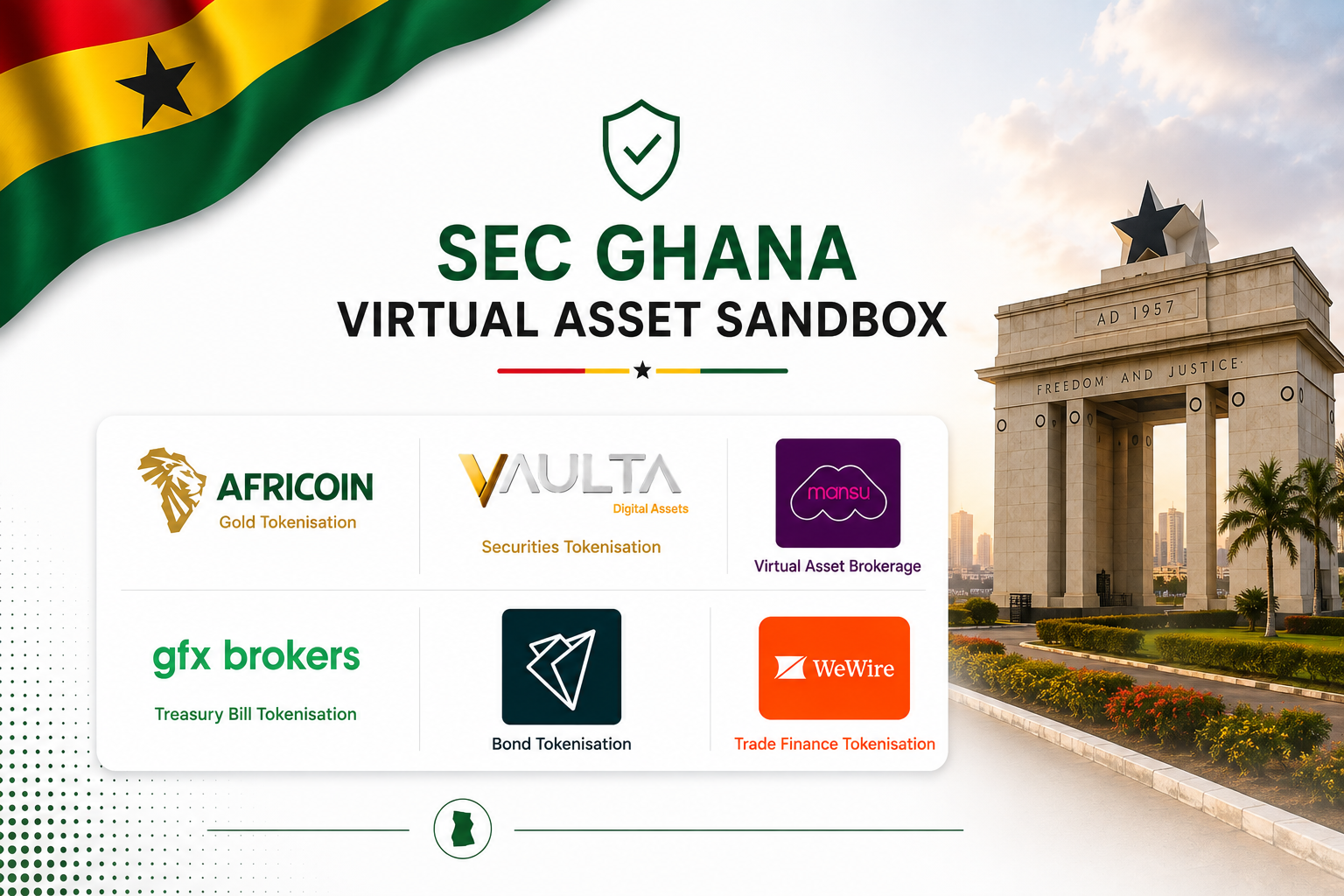
The SEC has admitted six firms into the regulatory sandbox, covering a range of tokenisation and brokerage use cases.
| Virtual Asset Service Provider | Approved Pilot Activity |
|---|---|
| Africoin Ghana Limited | Asset Tokenization (Gold) |
| Vaulta Digital Assets Ltd | Asset Tokenization (Securities) |
| GFX Brokers Limited | Asset Tokenization (Treasury Bills) |
| One Africa Securities Ltd | Asset Tokenization (Bonds) |
| WeWire Ghana Limited | Asset Tokenization (Trade Finance) |
| Mansu Technologies Ltd | Virtual Asset Brokerage |
A Strong Focus on Real-World Asset Tokenisation
One of the most striking aspects of Ghana’s sandbox is its emphasis on real-world asset (RWA) tokenisation. Five of the six approved projects focus on tokenising traditional financial or physical assets, including:
- Gold
- Government Treasury Bills
- Bonds
- Securities
- Trade Finance instruments
This reflects a regulatory approach that prioritises practical financial infrastructure over speculative digital assets. By allowing firms to experiment with tokenised versions of established asset classes, the SEC is exploring how blockchain technology can improve capital markets, investment accessibility, settlement efficiency and financial inclusion.
The inclusion of a virtual asset brokerage participant also demonstrates that the regulator is testing broader market infrastructure alongside tokenisation initiatives.
According to the SEC, the sandbox will enable the regulator to gather operational and supervisory insights that will inform the validation and finalisation of licensing guidelines for virtual asset service providers.
Rather than regulating emerging technologies solely through theory, Ghana is allowing innovation to occur within a supervised environment where regulators can observe business models, identify potential risks and refine regulatory expectations before introducing a full licensing framework.
This approach reduces uncertainty for both regulators and market participants while encouraging responsible innovation.
What This Means for Ghana’s Digital Asset Industry
The publication of the full participant list provides greater certainty for industry stakeholders and demonstrates that Ghana’s virtual asset framework is moving beyond policy discussions into implementation.
The range of approved pilots also signals where the regulator currently sees the greatest opportunities for blockchain technology, particularly in modernising traditional financial markets through tokenisation.
As the sandbox progresses, the lessons generated from these pilot projects are expected to shape Ghana’s long-term regulatory framework for virtual asset service providers and lay the foundation for a more structured digital asset ecosystem.
With regulated experimentation now underway, Ghana continues to position itself among the African jurisdictions taking a measured, innovation-friendly approach to virtual asset regulation while maintaining investor protection and market integrity.